
Planning a route through Florence, Siena and San Gimignano sounds straightforward until you realize these three Tuscan gems aren’t connected the way you’d expect. One has no train station, another requires navigating Italian-language booking platforms, and the third involves figuring out whether those beautiful hop-on hop-off buses actually save you money compared to piecing together individual tickets. According to recent tourism data published in Florence, Tuscany recorded more than 10 million overnight stays in 2025, confirming that efficient intercity transport remains crucial for travelers tackling multi-city itineraries. The real question isn’t just about price — it’s whether you prioritize flexibility, tourist-friendly features, or authentic local transport. Options range from integrated services like Tootbus Tuscany offering multi-day hop-on passes with audio guides and pedestrian tours, to traditional regional buses and trains requiring more planning but potentially lower costs. This comparison breaks down four distinct approaches across the factors that actually matter when you’re standing at Santa Maria Novella station trying to decide your next move.
Your Tuscany transport choice in four key points:
- San Gimignano has no train station — bus access is mandatory, which changes your entire transportation strategy
- Four main approaches exist: integrated hop-on passes, regional trains, local public buses, and rental cars
- Your best option depends on whether you prioritize schedule freedom, minimum cost, or complete independence
- Booking complexity varies dramatically — some platforms operate in English with real-time tracking, others require navigating Italian regional transit sites
Why choosing the right Tuscany pass matters for your itinerary
Here’s what catches most first-time Tuscany visitors off guard. You can take a train between Florence and Siena smoothly, but San Gimignano has no rail access. As confirmed by the official municipal transport guide for San Gimignano, visitors must use the train-plus-bus connection via Poggibonsi station, or take direct bus services bypassing trains entirely.
This structural reality transforms your transportation decision from simple “train or bus” into nuanced evaluation. Booking separate train tickets for Florence-Siena then arranging additional bus connections for San Gimignano creates a patchwork itinerary requiring multiple bookings, potentially in Italian, across different operators. Integrated approaches bundle these connections, trading cost savings for significant convenience.
Consider a common scenario: A first-time Italy visitor planning five days in Tuscany books separate Florence-Siena train tickets online, assuming all three cities connect by rail. Upon arrival, they discover San Gimignano requires an additional bus from Poggibonsi station — a connection not obvious on English-language booking platforms. What seemed like simple point-to-point tickets becomes a fragmented itinerary across three different operators, two languages, and uncertain transfer timing. Integrated pass solutions eliminate this discovery-upon-arrival frustration by bundling all necessary connections upfront.
Flexible passes eliminate rebooking pressure, letting you adapt timing to what you actually encounter rather than what you predicted weeks ago.

The key factors that should guide your choice
Comparing transportation options purely on base ticket price misses roughly half of what determines whether your Tuscany experience feels smooth or stressful. The total cost equation includes obvious elements like fares, but also hidden factors such as whether you’ll need to book multiple legs separately, pay onboard surcharges for last-minute purchases, or budget for parking fees if you rent a car.
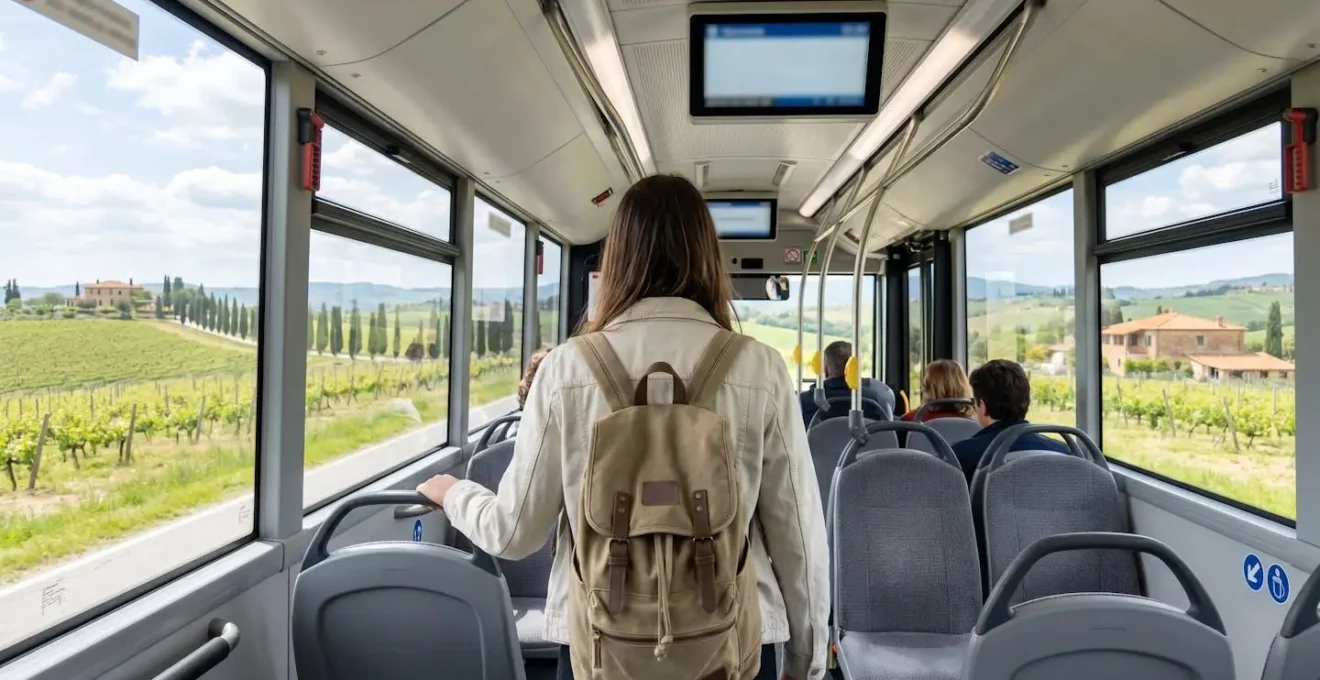
Booking complexity varies dramatically across options. Integrated services typically offer English-language platforms with real-time tracking, instant confirmation, and customer support accessible to non-Italian speakers. Regional public transport — while often cheaper — may require navigating Italian-primary booking interfaces, understanding zone-based fare structures, and managing separate accounts across multiple operators. The time investment in research and booking itself becomes a hidden cost that some travelers underestimate when comparing pure ticket prices.
Luggage handling also influences the comparison. Hop-on buses and rental cars accommodate suitcases without restrictions, while crowded regional trains during peak season can make managing large bags stressful. If you’re moving between accommodations in all three cities rather than day-tripping from a single base, this practical logistics factor shifts from minor detail to meaningful decision criterion.
Schedule flexibility operates on a spectrum. At one end, you have hop-on hop-off services where you simply board the next available bus without prebooking specific departure times. At the other end sit advance-purchase train tickets that lock you into precise schedules with penalties for changes.
The San Gimignano access factor: This medieval hill town receives millions of visitors annually despite having zero train stations. Every traveler reaching San Gimignano relies on bus connections, either direct services from Florence and Siena or transfers from Poggibonsi rail station. This structural constraint means your transportation choice must accommodate bus travel regardless of whether you prefer trains for other segments — you can’t avoid buses entirely while including San Gimignano in your route.
Tourist experience integration separates basic transport from value-added services. Some options simply move you between cities, while others bundle audio guides, pedestrian walking tours, multilingual digital assistance, and partnerships with local attractions. Whether those extras matter depends on your travel style — independent explorers comfortable researching their own context might skip integrated features entirely, while first-time Italy visitors often appreciate curated information delivered automatically.
- Calculate total journey cost including all three cities plus any connection fees or onboard surcharges
- Assess schedule flexibility — do you need fixed departure times or prefer spontaneous boarding
- Verify San Gimignano access method — direct bus service versus train-plus-bus transfer complexity
- Consider included tourist features like audio guides, walking tours, or real-time tracking apps
- Check booking platform language support — English interfaces versus Italian-primary regional sites
- Match the solution to your comfort level navigating foreign public transport systems independently
Your four main options: an honest comparison
The Tuscany intercity transport landscape offers four distinct approaches, each optimized for different traveler profiles. The practical question becomes which trade-offs align with your specific situation — whether you’re a budget-conscious backpacker comfortable with complexity, a first-time Italy visitor prioritizing ease, or an independent explorer wanting maximum route control.
The comparison below synthesizes current 2026 data across strategic criteria. Pricing reflects typical costs for visiting all three cities during a multi-day trip.
Data compiled and updated February 2026 from official operator sources and regional transportation authorities.
| Transport Option | Total Cost (3 cities) | Journey Time | Schedule Flexibility | San Gimignano Access | Tourist Integration | Booking Ease | Best For |
|---|---|---|---|---|---|---|---|
| Tootbus Tuscany Multi-Day Pass | Premium pricing (~€50-80 multi-day) with all routes/amenities included | Flexible departures, ~90-120 min total journey | Complete hop-on freedom, no prebooking required | Direct service on Terracotta Route | Audio guides, Tootwalk tours, Tootie AI (50+ languages), WiFi | English app, real-time tracking | First-time visitors wanting stress-free logistics and cultural content |
| Trenitalia Regional Trains | ~€9-12 Florence-Siena regional (+ separate bus for San Gimignano) | 75-90 min Florence-Siena + 50-70 min Poggibonsi-San Gimignano (transfer) | Fixed schedules, advance booking recommended | Requires separate bus from Poggibonsi (transfer complexity) | Basic transport only | Italian-primary website, some English | Budget travelers comfortable with transfers and planning |
| SITA/Tiemme Regional Buses | According to official Autolinee Toscane fare schedules, ~€14-€22 point-to-point (San Gimignano-Siena €6.90, San Gimignano-Florence €7.50) | Direct routes, ~90-120 min similar to Tootbus | Published timetables, some flexibility with multiple daily departures | Direct routes to all three cities | Authentic local experience, minimal tourist amenities | Regional platforms, Italian prevalent | Independent travelers seeking authentic local transport |
| Rental Car with Parking | Daily rental plus fuel, tolls, parking fees (ZTL zones restricted) | 60-90 min driving time (traffic dependent) | Complete schedule independence | Direct drive, limited parking near historic centers | Flexibility for countryside exploration | Standard international rental | Travelers planning extensive countryside visits, comfortable with Italian driving/ZTL restrictions |
How Tootbus Tuscany simplifies multi-city exploration
When travelers piece together separate tickets across multiple Italian regional operators, they’re building their own intercity network from scratch. Tootbus Tuscany inverts that model by providing a pre-integrated system designed specifically for the tourist corridor these three cities represent, addressing “how do I experience Florence, Siena, and San Gimignano efficiently without transportation logistics consuming vacation mental energy.”
The operational mechanics work through duration-based passes (2-day, 3-day, or 5-day options) that activate only when first scanned onboard, eliminating “use it or lose it” countdown anxiety. The Terracotta Route directly serves all three cities without transfers. Travelers simply board at any stop, scan their pass, and ride to their destination, repeating as often as wanted during validity without additional costs or prebooking.
Tourist-focused integration extends beyond transportation through features addressing common Italy travel friction points. The included Tootwalk audio-guided walking tours provide structured city exploration upon arrival, while Tootie’s AI assistant operating in 50+ languages answers questions from “where’s the nearest restroom” to “explain this palazzo’s history” without Italian skills or constant searching. Free WiFi, reduced mobility accessibility, and real-time app tracking create an experience closer to premium tour services than basic public transport.
Matching your travel style to the right solution
The abstract comparison of features matters less than how those features align with your specific travel priorities and comfort zones. A solution that feels liberating for one traveler profile creates unnecessary expense for another, while an option praised as “authentic” might translate to “confusing” depending on your language skills and patience for problem-solving on vacation.
- If maximum flexibility to explore at your own pace matters most:
Tootbus Tuscany hop-on hop-off delivers unlimited boarding across the network without schedule constraints or prebooking stress, plus integrated cultural content through audio guides and pedestrian tours that enhance rather than complicate your experience.
- If achieving the lowest absolute cost takes priority and you’re comfortable with planning:
Regional trains supplemented by SITA/Tiemme buses offer the cheapest per-segment pricing, typically starting around €7-€15 for point-to-point routes, though you’ll manage multiple bookings, navigate Italian-language platforms, and handle the Poggibonsi transfer for San Gimignano access yourself.
- If you want complete independence to explore countryside beyond these three cities:
Rental cars provide maximum route control for visiting Chianti wineries, small villages, and rural areas without bus service, but factor in ZTL restrictions preventing direct access to historic centers, plus parking challenges and Italian highway tolls that reduce the cost advantage.
- If experiencing authentic local transportation appeals more than tourist-focused services:
SITA/Tiemme regional buses let you travel exactly how Italian residents move between cities, sharing space with local commuters and students, though this requires comfort navigating Italian booking systems, published timetables, and minimal English-language support.
Do I need to book Tuscany bus passes in advance or can I purchase on arrival?
Advance booking is recommended during peak summer months when tourism reaches maximum capacity, guaranteeing availability and often providing modest discounts versus walk-up rates.
Can I use a Florence-Siena train ticket to reach San Gimignano directly?
No — San Gimignano has no train station. You must take a separate bus either directly from Florence or Siena, or transfer to a connecting bus from Poggibonsi station. This transfer requirement is why many choose direct bus services or integrated passes rather than mixing trains and buses.
How long does traveling between these three cities typically take?
Florence to Siena ranges from 75 to 90 minutes depending on transport mode. Siena to San Gimignano takes approximately 50 to 70 minutes by direct bus. Florence to San Gimignano varies from 60 to 90 minutes. These don’t include waiting periods between connections, which can add 20 to 40 minutes when transferring.
Are multi-day passes worth the cost for just two or three days in Tuscany?
Value depends on your priorities beyond pure cost. If visiting all three cities, the convenience of unlimited boarding, elimination of multiple bookings, included amenities like audio guides, and freedom from schedule stress typically offset any modest price premium over pieced-together point-to-point tickets.
What happens if I miss my scheduled bus or train departure?
Fixed-schedule options like regional trains require catching the next available departure, potentially waiting 60 to 120 minutes. Hop-on hop-off passes eliminate this concern — you simply board the next bus without rebooking or penalties.
- Confirm exact travel dates and days needed to explore all three cities
- Identify your top priority — flexibility, minimum cost, independence, or authentic experience
- Calculate total costs including all segments, transfer fees, and surcharges
- Book 7-14 days ahead during peak season for availability and discounts
- Download relevant apps before departure — tracking, offline maps, translation tools
The right Tuscany transportation choice emerges not from identifying an objectively “best” option, but from matching solution characteristics to your specific travel style, budget tolerance, and comfort with navigation complexity. First-time Italy visitors typically benefit most from integrated services eliminating booking friction and language barriers, while experienced European travelers comfortable with regional transit systems can leverage local buses and trains for cost savings. The San Gimignano access constraint remains the common denominator — every approach must accommodate bus travel for that segment, which often tips the decision toward solutions treating buses as primary rather than fallback transportation.